Muse Wonder (max) - Intelligence, Performance & Price Analysis | Artificial Analysis
Key Points
- 1Released by Meta in October 2026, Muse Wonder (Max) is a proprietary reasoning model that supports multimodal inputs including text, image, speech, and video.
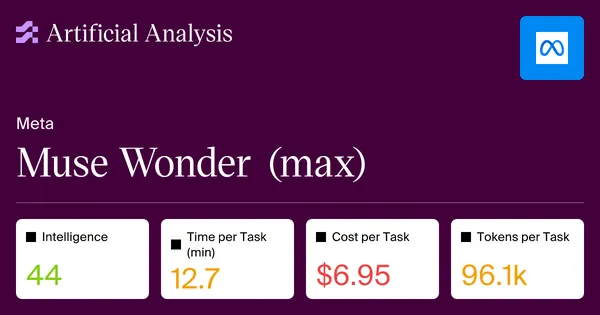
- 2The model achieves an above-average Artificial Analysis Intelligence Index score of 44, supported by a 1M token context window for complex, large-scale tasks.
- 3Despite its strong performance, the model is characterized as somewhat expensive and verbose, with pricing set at $4.00 per million input tokens and $20.00 per million output tokens.
Muse Wonder (Max), released by Meta in October 2026, is a proprietary, multimodal reasoning model supporting text, image, speech, and video inputs with text-only output. It features a 1M token context window and is classified as a reasoning model, utilizing chain-of-thought processing to address complex tasks.
Intelligence and Performance Metrics
The model is evaluated using the Artificial Analysis Intelligence Index v5.0.1, achieving a score of 44, which places it above the 40-point median for comparable models. This index is a composite measure derived from nine distinct benchmarks: AA-Briefcase v1.1, AutomationBench-AA, Terminal-Bench 4.0, FrontierCode 2.0, AA-Omniscience v1.1, GDP.pdf, HLE-Diamond, CritPt v2 (Hard Subset), and Terminal-Bench-Science 0.1.Performance metrics indicate a time-to-first-answer token of 20.35 seconds, reflecting the overhead associated with the model's reasoning phase. The output speed is measured at 125 tokens per second. In terms of verbosity, the model generated 113M tokens during the Intelligence Index evaluation, significantly higher than the median of 72.8M, suggesting a high tendency for detailed or expansive responses. The efficiency of the model in completing the Intelligence Index is 12.8 minutes per task.
Cost Structure
Pricing is tiered at 20.00 per 1M output tokens, with a 95% cache discount. The weighted average cost per task on the Intelligence Index is 2.94 per 1M tokens.Methodology
The Intelligence Index utilizes a weighted average methodology to synthesize performance across diverse agentic and reasoning capabilities. The cost-per-task () is calculated by aggregating the costs of specific token types—including input, cache hits, cache writes, reasoning, and output tokens—weighted by their relative importance within the index:Where:
- represents the quantity of tokens of a specific type for evaluation .
- represents the price per token type.
- represents the weight assigned to evaluation in the index.
- represents the number of tasks performed.
The AA-Omniscience v1.1 component of the methodology further refines knowledge reliability scores by penalizing hallucinations () while rewarding accuracy () without penalizing refusals, represented as:
The model's personality and communication style are assessed via AA-PersonalityBench, which benchmarks expressiveness, organizational structure, transparency, and the presence of filler ("slop"), utilizing Elo-based z-score rankings across evaluated models.