Paper
Muse Ember (max) - Intelligence, Performance & Price Analysis | Artificial Analysis
Artificial Analysis
2026.11.10
·Service·by 성산#AI#DL#LLM#ML#RAG
Key Points
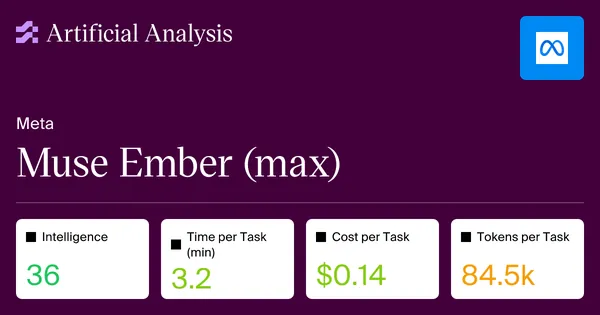
- 1Meta’s Muse Ember (Max), released in November 2026, is a proprietary reasoning model that achieves an Artificial Analysis Intelligence Index score of 36, significantly outperforming the median score of 24.
- 2The model offers highly competitive pricing at $0.10 per million input tokens and $0.50 per million output tokens, while maintaining a 1-million-token context window.
- 3Demonstrating strong operational efficiency, Muse Ember (Max) processes tasks in 3.2 minutes with a 4.37-second time to first answer token, positioning it as both faster and more cost-effective than typical models in its class.
Muse Ember (Max) is a proprietary reasoning model developed by Meta, released in November 2026. According to the Artificial Analysis Intelligence Index, it achieves a score of 36, significantly outperforming the median score of 24 for comparable models.
Core Methodology and Evaluation
The model’s intelligence is quantified via the Artificial Analysis Intelligence Index (v5.0.1), a composite benchmark that aggregates performance across nine distinct domains: AA-Briefcase v1.1 (agentic knowledge work), AutomationBench-AA (SaaS workflows), Terminal-Bench 4.0 (coding/terminal use), FrontierCode 2.0 (repository-level software engineering), AA-Omniscience v1.1 (knowledge reliability/hallucination rates), GDP.pdf (document reasoning), HLE-Diamond (reasoning and knowledge), CritPt v2 (physics reasoning), and Terminal-Bench-Science 0.1 (scientific research workflows).The methodology utilizes a weighted average cost and performance framework. The total weighted cost per task () is derived from the costs associated with input, cache hits, cache writes, reasoning, and output tokens ():
where represents the weight of evaluation . The performance is measured via "Time per Intelligence Index Task," calculated as the ratio of output tokens produced per task to the model's end-to-end output speed.
Performance and Technical Specifications
Muse Ember (Max) is categorized as a "reasoning" model, meaning it employs extended chain-of-thought processing before yielding an output. Key technical benchmarks include:- Latency: A time-to-first-answer-token of 4.37s and an output speed of 446 tok/s.
- Efficiency: It completes tasks in 3.2 minutes, which is faster than the median of 7.5 minutes for its peer group.
- Verbosity: The model generates 115M output tokens across the index, indicating a higher-than-average verbosity (median: 90M).
- Context: It supports a 1M token context window, equivalent to approximately 1,573 pages of 12-point Arial font.
- Modality: The model is multimodal, accepting both text and image inputs while providing text outputs.