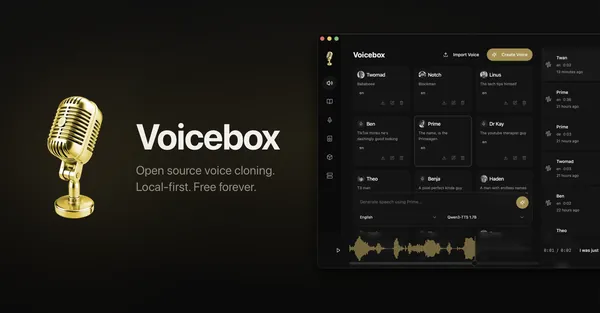
Voicebox
Key Points
- 1Voicebox is a free, open-source AI voice studio designed for local operation, enabling voice cloning, speech generation, and dictation entirely on your machine without cloud dependencies.
- 2It offers advanced features including near-perfect voice cloning from minimal audio, a multi-voice stories editor, real-time audio effects, and Whisper-powered dictation with AI-refined transcripts.
- 3The platform supports a wide range of local TTS and transcription models, provides a built-in REST API for programmatic control, and allows users to define unique personalities for cloned voices.
Voicebox is an open-source, local-first AI voice studio designed to provide comprehensive tools for voice cloning, speech generation, and multi-voice content creation, operating entirely on the user's machine without cloud dependencies, subscriptions, or fees. It serves as a free alternative to cloud-based services like ElevenLabs.
The core methodology revolves around leveraging a suite of locally runnable, open-source machine learning models for various speech-related tasks. The system is engineered for on-device inference, supporting GPU acceleration via Metal, CUDA, ROCm, Intel Arc, or DirectML, and also offering CPU-friendly options.
Key features and their underlying technical mechanisms include:
- Near-Perfect Voice Cloning: This is achieved by training or adapting models from a few seconds (as little as 3 seconds) of audio. The specific techniques likely involve few-shot learning or speaker adaptation layers on pre-trained Text-to-Speech (TTS) models to capture unique vocal characteristics, intonation, and emotion.
- Multiple TTS Engines: Voicebox integrates a variety of TTS models, each with distinct architectures and capabilities:
- Qwen3-TTS by Alibaba (1.7B, 0.6B parameters): A high-quality, multilingual cloning model known for natural prosody. Its notable feature is support for "delivery instructions," enabling users to control tone, pace, and emotion using natural language prompts (e.g., "warm, slow, cinematic"). This suggests an architecture that conditions speech generation on both text and natural language style descriptors, possibly via an encoder-decoder framework with a style encoder.
- Chatterbox by Resemble AI: Offers production-grade voice cloning with broad language support (23 languages) and explicit emotion exaggeration control, implying fine-grained control over prosodic features.
- Chatterbox Turbo by Resemble AI (350M parameters): A lightweight and fast variant, supporting paralinguistic tags (e.g.,
[laugh],[sigh],[gasp]) embedded directly in the input text. This indicates the model is trained to generate specific non-verbal vocalizations based on predefined text tokens. - LuxTTS by ZipVoice: Optimized for speed and CPU efficiency, achieving over 150x real-time performance at 48kHz, suggesting highly optimized neural architectures or specialized inference techniques.
- Qwen CustomVoice by Alibaba (1.7B, 0.6B parameters): Provides premium preset speakers with natural-language style control, similar to Qwen3-TTS, where the model adapts tone and pace based on descriptive instructions.
- TADA by Hume AI (3B, 1B parameters): A speech-language model featuring text-acoustic dual alignment, designed for long-form audio generation (over 700 seconds) without drift. This likely involves sophisticated attention mechanisms or context-window management to maintain coherence over extended sequences.
- Kokoro by hexgrad (82M parameters): A tiny, CPU-real-time TTS model with pre-built voice styles, emphasizing efficiency and low resource consumption.
- Audio Transcription (Speech-to-Text): Powered by OpenAI's Whisper models.
- Whisper (1.5B, 769M, 244M, 74M parameters): A robust multilingual Automatic Speech Recognition (ASR) model, available in various sizes to balance accuracy and performance.
- Whisper Turbo (809M parameters): A pruned version of Whisper Large v3, achieving near-best quality at approximately 8x the speed, making it suitable for real-time dictation. These models typically employ a transformer-based encoder-decoder architecture.
- Language Models (LLMs):
- Qwen3 by Alibaba (4B, 1.7B, 0.6B parameters): Used for advanced text processing tasks such as transcript refinement (cleaning "ums," self-corrections, punctuation), generating persona-based replies, and powering the voice I/O loop. This indicates its use in natural language understanding and generation tasks to enhance the output from ASR and guide TTS.
- Multi-Voice Content Creation (Stories Editor): A timeline-based editor allows arranging tracks, trimming clips, and mixing conversations. While not a core ML methodology, it's a key application layer for the generated speech.
- Audio Effects Pipeline: Applies digital signal processing (DSP) effects like pitch shift, reverb, delay, and compression.
- Dictation and Agent Interaction: Dictation functionality uses Whisper for real-time speech-to-text, with an optional Qwen3 LLM for "refining" transcripts by removing disfluencies. Agents (e.g., Claude Code) can speak back using cloned voices via the MCP (Machine Control Protocol) or other custom API calls, integrating the TTS capabilities into AI agent workflows. This highlights the modularity and API-driven design.
- Personalities Feature: Allows assigning a free-form "personality" description to any voice profile. The Qwen3 LLM can then "Rewrite" text in that character's voice or "Compose" fresh lines based on the personality. This demonstrates fine-tuning or prompt engineering of the LLM to generate text in a specific stylistic persona, which is then voiced by the cloned TTS model.
- Built-in REST API: Every downloaded engine becomes a local REST endpoint (e.g.,
POST /generate). This provides programmatic control for developers to integrate Voicebox into custom applications, games, and scripts without API keys, rate limits, or per-character fees, as all processing is local.
In essence, Voicebox orchestrates a collection of state-of-the-art, open-source neural networks for speech synthesis (TTS), speech recognition (ASR), and natural language processing (LLM) to deliver a comprehensive, privacy-preserving, and highly controllable voice creation platform entirely on the user's hardware.