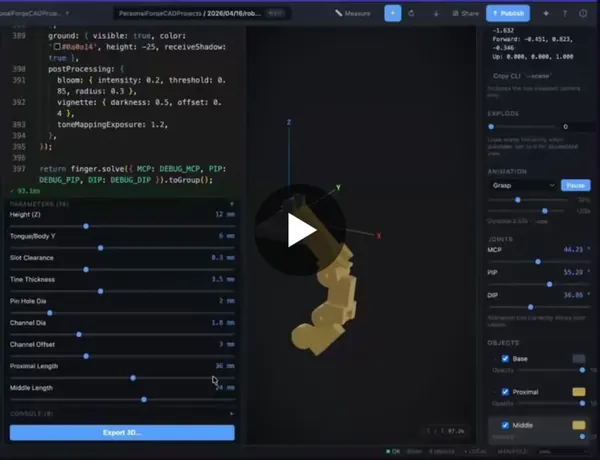
Claude Opus 4.7 tops CAD benchmarks - and AI is starting to design functional hardware. We’re watching the shift from CAD as a tool → CAD as an autonomous system: The model didn’t just sketch… | Vlad Larichev | 46 comments
Key Points
- 1The paper discusses how AI, specifically LLMs, is transforming CAD from a design tool into an autonomous system capable of generating mechanically valid and functional hardware.
- 2This shift parallels changes in software development, redefining the engineer's role from manual design to defining intent, setting constraints, and validating AI-generated outputs.
- 3The move towards "intent-defined" engineering necessitates precise constraint definition and robust validation infrastructure, as the primary challenge shifts to ensuring AI-generated designs meet complex, often implicit, real-world requirements.
This paper describes a transformative shift in Computer-Aided Design (CAD) and mechanical engineering, driven by advancements in Artificial Intelligence (AI), specifically Large Language Models (LLMs). The central assertion is that AI is enabling CAD to evolve from a mere tool into an autonomous system capable of generating functional hardware designs.
The core evidence for this shift is the performance of models like Claude Opus 4.7, which reportedly excel in CAD benchmarks by generating mechanically valid designs, including complex elements like joints and motion constraints. These AI-generated outputs are optimized for real-world functionality rather than just visual correctness and are directly usable within existing CAD workflows with minimal rework. This paradigm shift is analogized to recent developments in software engineering, where AI systems now generate code, allowing human engineers to focus on higher-level tasks such as requirements definition, architecture, and orchestration.
The underlying methodology enabling this is partly attributed to projects like Forgecad, which implements parametric CAD in JavaScript. This approach leverages LLMs' proficiency in JavaScript and web development, suggesting that instead of teaching AI to interact with traditional CAD software, CAD itself can be reframed as a web development project that LLMs can directly generate and manipulate via code. This implies that detailed geometric design could be expressed programmatically, moving beyond graphical interfaces.
This evolution has profound implications for the role of mechanical engineers and traditional CAD workflows. Engineers will transition from manually designing individual components to defining high-level intent, specifying design constraints, and validating the AI-generated outputs. Their focus will ascend to system-level architecture. The post questions whether manufacturing is shifting from "software-defined" to "prompt-defined," or more precisely, "intent-defined" engineering, a term preferred by commentators.
However, the paper also highlights significant challenges and nuances through various expert comments:
- Contextual Integration: AI-generated designs may lack context regarding organizational best practices, existing inventory, or Enterprise Resource Planning (ERP) systems. Effective AI-CAD solutions must integrate with an organization's knowledge bases and industry standards to be truly useful.
- Complexity Distinction: There's a distinction between AI designing simple geometric placeholders and tackling highly complex tasks like tool and die design, intricate molding, casting parts, or Class A surfacing, where current CAD kernels have mathematical limitations for exact surface descriptions. While AI may eventually address these, it implies a more distant future for full autonomy in highly specialized domains.
- Cognitive Relocation: The engineer's role does not diminish but "relocates." Defining precise and comprehensive constraints for AI becomes a more demanding cognitive task. A poorly specified prompt can lead to designs that appear valid but fail at the system integration level, such as issues with assembly tolerance stacks in production.
- Validation Infrastructure: Within a 2-3 year horizon, the primary bottleneck will not be the AI's generation quality but the lack of robust "validation infrastructure." This includes tools and processes to verify that AI-generated geometry meets implicit requirements that experienced engineers traditionally hold but are rarely formally documented.
- Cost and Off-the-Shelf Components: For hardware design constrained by budget, AI's tendency to generate unique geometries from scratch might conflict with the need to utilize existing, cost-effective off-the-shelf components. Future systems would need to incorporate inventory awareness.
- Autonomous vs. Production-Ready: While AI can generate designs, "autonomous doesn't mean production-ready." Directed workflows, where engineers meticulously define intent, remain crucial. Some suggest that local, independent, private AI pipelines might offer more control and practical possibilities than centralized LLMs.
In summary, the paper posits that AI is fundamentally reshaping CAD from a manual tool to an autonomous design system, pushing engineers towards conceptual mastery and intent definition. However, successful implementation requires addressing critical issues related to contextual integration, the complexity of design tasks, the demanding nature of prompt engineering, the development of robust validation infrastructure, and the strategic integration of AI with existing supply chain and cost considerations.