VoMP: Predicting Volumetric Mechanical Property Fields
Key Points
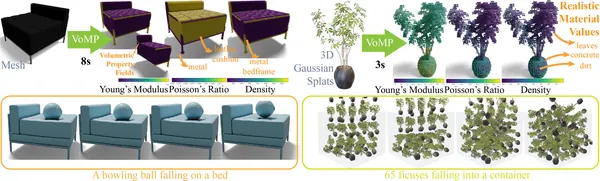
- 1VoMP presents the first feed-forward model capable of predicting fine-grained volumetric mechanical properties—Young's modulus, Poisson's ratio, and density—for 3D objects from diverse representations such as Gaussian Splats, Meshes, and NeRFs.
- 2The pipeline aggregates multi-view features per voxel, processes them with a Geometry Transformer to predict latent material codes, and decodes these using a MatVAE trained on physically valid data to ensure plausible properties.
- 3This approach generates accurate and valid mechanical property fields, enabling realistic deformable simulations and producing simulation-ready assets that significantly outperform prior art.
VoMP (Volumetric Mechanical Property fields) is a novel feed-forward model designed to predict fine-grained, spatially-varying mechanical properties, specifically Young's modulus (), Poisson's ratio (), and density (), throughout the volume of 3D objects. This innovation addresses the challenge of laboriously hand-crafting such properties for physical simulations, enabling the conversion of raw 3D assets into simulation-ready objects.
The core methodology of VoMP involves a multi-stage pipeline. The first stage establishes a physically plausible material space using a trained MatVAE (Material Variational Autoencoder). This VAE learns a compact 2D latent space representing physically valid triplets of (, , ), trained on a comprehensive dataset of 100,000 such triplets. The learned latent manifold ensures that all decoded material properties are physically sound.
The input to VoMP is a 3D representation, which can be any format amenable to rendering and voxelization, including Signed Distance Fields (SDFs), Gaussian Splats, or Neural Radiance Fields (NeRFs). For a given 3D input, the model first renders it from multiple viewpoints. These multi-view rendered images are then used to extract and aggregate per-voxel image features, which are subsequently reconstructed onto the 3D voxel grid corresponding to the object's volume.
The voxels, now enriched with aggregated image features, are fed into a specialized deep learning architecture called the Geometry Transformer. This transformer is trained to predict per-voxel material latent codes. Crucially, these predicted latent codes are constrained to reside within the learned 2D latent space of the MatVAE, thus ensuring their physical validity.
Finally, these per-voxel latent codes are passed through the decoder component of the pre-trained MatVAE. The MatVAE decoder reconstructs the full per-voxel material properties, yielding the spatially-varying fields of Young's modulus (), Poisson's ratio (), and density () for the entire 3D object.
To facilitate the training of the Geometry Transformer and the overall VoMP system, the authors propose an innovative annotation pipeline for generating object-level training data. This pipeline systematically combines knowledge derived from segmented 3D datasets, comprehensive material databases, and insights from vision-language models to automatically label objects with their corresponding ground truth mechanical properties.
Experimental evaluations demonstrate that VoMP accurately estimates volumetric mechanical properties. The predicted properties enable realistic deformable physical simulations, as shown in various scenarios, including robotic arm interactions, large-scale environmental simulations (e.g., a dozer interacting with trees), and object-object collisions (e.g., bowling ball impacting an armchair). Comparative analyses against prior state-of-the-art methods like NeRF2Physics, PUGS, Phys4DGen, and PIXIE consistently show that VoMP achieves significantly superior results in both the accuracy of the predicted property fields and the realism of subsequent physical simulations. Furthermore, VoMP demonstrates the capability to correctly predict material properties for internal volumetric structures of objects.