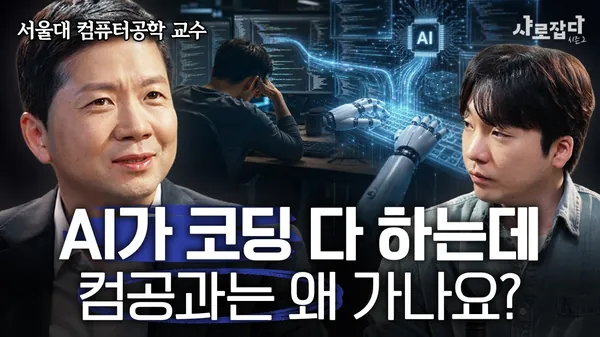
What Should Computer Science Students Learn in the AI Era? | SNU Professor Lee Jae-wook | SNU Catch
Key Points
- 1While AI will likely automate nearly all code generation, the essence of computer science remains in computational thinking, defining complex problems, and creating solutions, rather than just manual coding.
- 2The rise of AI as a "great equalizer" shifts the developer's role toward becoming an engineering manager who must possess the technical intuition to critique, evaluate, and integrate AI-generated outputs effectively.
- 3Academic curricula must evolve from textbook-based exercises to AI-native, design-oriented projects that cultivate students' ability to identify real-world problems and develop high-quality, practical solutions.
This paper presents a professional discussion between host Choi Seong-woon and Professor Lee Jae-wook of Seoul National University’s Department of Computer Science and Engineering regarding the paradigm shift in software development driven by Artificial Intelligence. The core of the discourse centers on how AI is transforming the field from manual coding to an AI-augmented, design-centric discipline.
The Evolution of Development: From Coding to Architecture
The traditional approach of "coding by hand" is being rapidly displaced. Professor Lee posits that automated code generation could soon approach 100% efficiency for standard programming tasks. Consequently, the role of a developer is shifting from that of a "writer" of code to a "manager" of AI agents. The primary task of a developer is now to identify, define, and decompose complex problems into actionable structures, delegating the implementation layer to AI.The Criticality of Technical Foundation
Despite the automation of syntax and basic logic, a deep grounding in computer science remains essential. The paper highlights two core pillars that sustain the value of computer science education:- Computational Thinking: The ability to decompose complex, messy real-world problems into simple, logical, and algorithmic steps.
- Data-Centric Thinking: The ability to analyze data distributions and derive actionable insights from complex systems.
Technical "taste" or intuition—the ability to discern a high-quality solution from a flawed one—can only be acquired through hands-on engineering experience. Professor Lee emphasizes that one cannot effectively manage AI agents without an internal understanding of the underlying engineering mechanics. If an AI generates a solution that is 99% accurate, the remaining 1% of errors in high-scale systems (e.g., finance, security) can be catastrophic; therefore, the role of the human "critic" or "judge" is increasingly vital.
Educational Paradigm Shifts
The paper argues that traditional curriculum—often based on textbook problems—is now obsolete because AI can solve such problems with 100% accuracy, rendering the student a mere "middleman" or "delivery person" for the answer. To restore meaningful learning, the proposed educational model involves:- Problem Definition: Shifting from solving predefined problems to creating open-ended designs with minimal constraints.
- Critical Assessment: Training students in "code criticism," where they evaluate AI-generated outputs for efficiency, security, and scalability.
- The "Gibalja" (Planner + Developer) Model: Encouraging students to possess domain-specific expertise combined with engineering capability, allowing them to bridge the gap between business needs and technical realization.
The "Great Equalizer" and the Future
The emergence of AI is described as a "Great Equalizer," as it resets the playing field for both veterans and beginners, giving everyone access to the same tools and potential for innovation. The paper concludes that while the value of manual code writing has diminished, the value of computer science as a discipline is actually rising. As AI expands the total addressable market for software (Jevons Paradox), the ability to design systems and solve domain-specific problems becomes the most critical asset for future professionals.In terms of technical growth, the paper identifies the gap in productivity as a function of the user's ability to define the boundaries of the model:
The "capability overhang"—the discrepancy between rapid AI model maturation and the slower, lagging development of human user skills—is where the competitive advantage will reside for future software engineers.