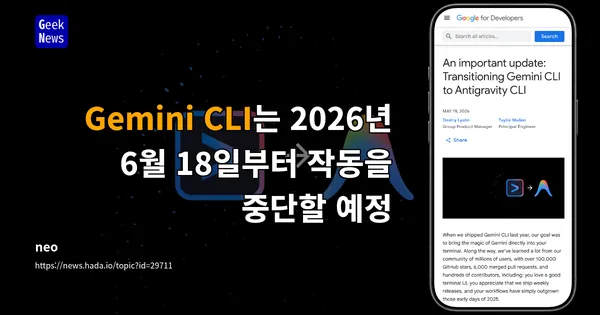
Gemini CLI는 2026년 6월 18일부터 작동을 중단할 예정 | GeekNews
Key Points
- 1Google is sunsetting the Gemini CLI and related Gemini Code Assist IDE extensions for most users by June 18, 2026, to consolidate efforts into the new, multi-agent focused Antigravity CLI.
- 2The Antigravity CLI, built with Go for improved performance and asynchronous workflows, will offer a new terminal experience, though it initially lacks full feature parity with its predecessor, while enterprise access remains unaffected.
- 3This move has been met with significant developer criticism, highlighting Google's recurring pattern of discontinuing popular products, confusing branding, and perceived neglect of user adoption and feedback.
Google is deprecating its Gemini Command Line Interface (CLI) and Gemini Code Assist Integrated Development Environment (IDE) extensions, with request processing ceasing for Google AI Pro, Ultra, and Free users (including Gemini Code Assist for individuals) on June 18, 2026. This transition is part of Google's strategic consolidation of its AI development efforts into a single, unified product: the Antigravity CLI.
The rationale behind this shift is to align with evolving user workflows that increasingly require multi-agent orchestration for complex problem-solving. While Gemini CLI gained significant adoption with millions of users and substantial GitHub engagement, Google aims to focus its resources on a single product designed for this multi-agent paradigm.
The Antigravity CLI is described as a Go-based terminal experience that integrates with a powerful server-side harness. This architecture is intended to provide a faster and more responsive execution environment, supporting asynchronous workflows to prevent terminal sessions from locking during compute-intensive tasks like large-scale refactoring or multi-topic investigations. It shares a common agent harness with other Antigravity products, such as Antigravity 2.0 and a new desktop application, ensuring that core agent improvements are universally applied across the ecosystem.
Key functional capabilities of Antigravity CLI include support for "Agent Skills," "Hooks," "Subagents," and "Extensions" (provided as Antigravity plugins). It is designed to facilitate quick evidence-based answers, scaffolding and implementation of new coding projects, and assistance with cloud infrastructure provisioning.
Antigravity CLI is slated for general availability to all users starting May 19, 2026. While consumer-level access to Gemini CLI and Gemini Code Assist IDE extensions will cease, enterprise customers using Gemini Code Assist Standard or Enterprise licenses, or those accessing Gemini Code Assist for GitHub via Google Cloud, will maintain their access rights. Furthermore, Gemini CLI will remain accessible for users with paid Gemini and Gemini Enterprise Agent Platform API keys. Antigravity CLI is designed for immediate integration with Google Cloud projects.
The community reaction, particularly noted in the provided commentary, highlights significant concerns regarding Google's product strategy and branding. Criticisms include the perceived lack of consistent product naming (e.g., "Gemini" vs. "Antigravity"), frequent product abandonments (dubbed "Google Graveyard"), and a perceived disconnect between Google's internal priorities and user experience. Users express frustration over the initial lack of 1:1 feature parity between Gemini CLI and Antigravity CLI, despite the latter being the designated successor. There are also reports of difficulties in account eligibility and subscription management for the new Antigravity services, with some users unable to access benefits despite being paying subscribers to Google AI plans. The fact that Gemini CLI was open-source (Apache 2) while Antigravity CLI is not (though Google has indicated potential future open-sourcing) also raises concerns about control and community contribution. The perceived short transition period (one month for some aspects) and Google's history of deprecating widely used products contribute to a sentiment of distrust among developers regarding the long-term viability of Google's public-facing AI tools.