MiniMax M3: Frontier Coding, 1M Context, Native Multimodality — All in One Model - MiniMax Research
Key Points
- 1MiniMax M3, a new open-weight frontier model, has been released, distinguished by its MSA sparse attention architecture enabling 1M token context, native multimodal capabilities, and desktop operation.
- 2M3 demonstrates state-of-the-art performance on coding benchmarks like SWE-Bench Pro, multimodal tasks, and agentic evaluations, proving its ability to excel in complex, real-world scenarios such as independent paper reproduction and CUDA kernel optimization.
- 3The model is accessible via MiniMax Code, Token Plans, and API services, aiming to foster developer collaboration with its long-horizon agentic capabilities and continuous self-correction mechanisms for complex tasks.
MiniMax M3 is a newly released frontier-level open-weight multimodal large language model, demonstrating state-of-the-art performance in specialized tasks such as coding and agentic work. It integrates three key capabilities: ultra-long context windows up to 1 million tokens, native multimodality supporting image and video input, and the ability to operate a desktop computer. M3 is the first open-weight model to combine these features, which are increasingly considered "table stakes" for closed-source frontier models.
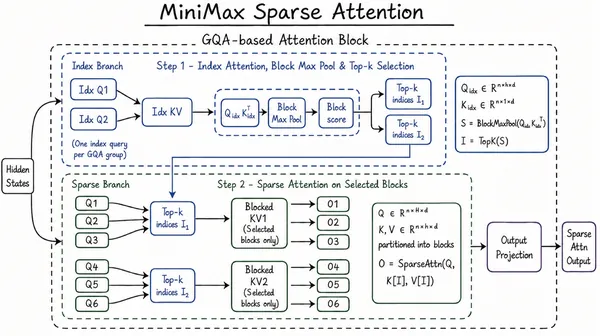
A core innovation enabling M3's capabilities, particularly its extended context window, is the MiniMax Sparse Attention (MSA) architecture. MSA addresses the inherent quadratic computational complexity growth of full attention mechanisms, which is represented by where is the sequence length. Unlike traditional attention, MSA employs a novel sparse attention mechanism that avoids this complexity explosion by efficiently partitioning Key-Value (KV) pairs into blocks. Specifically, MSA partitions the KV space more precisely than other sparse approaches like DSA and MoBA, leading to higher effective context coverage. At the operator level, MSA utilizes a "KV outer gather Q" approach. This method processes KV blocks as the outer loop, aggregating queries that hit specific blocks. Each KV block is read only once, and memory access is contiguous, significantly improving arithmetic intensity. This design results in over 4 times faster processing compared to open-source Flash-Sparse-Attention and flash-moba. For a 1 million token context, M3's per-token compute is reduced to 1/20th that of previous-generation models, achieving speedups of over 9 times in the prefilling stage and over 15 times in the decoding stage. Despite its efficiency gains, MSA has been shown in ablations to match full attention on the vast majority of capabilities.
M3 demonstrates frontier-level performance across various benchmarks. On coding benchmarks, it surpasses GPT-5.5 and Gemini 3.1 Pro on SWE-Bench Pro (59.0%), approaches Opus 4.7, and achieves high scores on Terminal-Bench 2.1 (66.0%), SWE-fficiency (34.8%), KernelBench Hard (28.8%), and MCP Atlas (74.2%). Its multimodal capabilities are highlighted by surpassing Opus 4.7 on SVG-Bench for SVG generation and scoring above Gemini 3.1 Pro on OmniDocBench. For end-to-end autonomous agent evaluation, M3 achieves the highest score on Claw-Eval.
The model's development emphasized frontier coding and agentic capabilities, moving beyond single-turn tasks to real-world collaborative scenarios. MiniMax developed an interactive user simulator framework to train and evaluate models in environments that closely mimic production, simulating developer behaviors such as requirement elaboration, solution discussion, feedback-based correction, continuous task switching, and complex project iteration. This approach aims to make M3 a reliable collaborative partner rather than just a passive instruction executor.
M3 is natively multimodal, having undergone mixed-modality training from "Step 0." This native integration fosters a more natural and deep merging of semantic spaces across different modalities. A key finding in its development was the critical importance of interleaved data (text, images, and other modalities naturally interleaved within a sequence) for improving model performance and scaling the overall training data, which can now reach orders of 100 trillion tokens due to a rebuilt data pipeline.
Real-world applications of M3 highlight its integrated capabilities:
- Independent Paper Reproduction: M3 autonomously reproduced an ICLR 2025 paper, "Learning Dynamics of LLM Finetuning." Over 12 hours, it generated 18 commits and 23 experimental figures, successfully matching prediction-probability trends, observing the squeezing effect, and verifying mitigation methods. This task required multimodal understanding of figures and formulas, 1M context to hold the paper, code, and logs, and strong coding/agentic capabilities for long-thread execution.
- CUDA Kernel Optimization: M3 was tasked with optimizing an FP8 matrix multiplication (GEMM) kernel for NVIDIA Hopper architecture GPUs, starting only with a task description, benchmark script, and a non-runnable Triton skeleton, requiring it to optimize from first principles. Over approximately 24 hours, M3 performed 147 benchmark submissions and 1,959 tool calls without human intervention. It conducted baseline implementation, autotune configuration, performance bottleneck diagnosis, CUDA Graph integration, persistent kernel rewriting, and host-side scheduling optimization. This process led to a 9.4 times speedup, improving Hopper FP8 hardware peak utilization from 7.6% to 71.3%. M3's persistence was notable, with its best solution appearing on the 145th submission, continuously exploring optimization directions even after performance plateaus.
- Autonomous Model Training (PostTrainBench): M3 was given four base models and tasked with autonomously completing the entire process of data synthesis, training, evaluation, and iteration within 12 hours to acquire basic capabilities across mathematical reasoning, tool calling, scientific knowledge reasoning, basic arithmetic reasoning, and code generation. While slightly below Opus 4.7 (0.42) and GPT-5.5 (0.39), M3 scored 0.37, demonstrating strong autonomous decision-making in open-ended research.
MiniMax Code, an agent product specifically designed and trained with M3, leverages these capabilities. It can break down large tasks into multi-stage, concurrent, and dynamically adjustable workflows, using an "Agent Team" with a Producer + Verifier adversarial harness loop for continuous self-correction. It supports autonomous operation for days and, through M3's native multimodal support, enables desktop operation (e.g., controlling ERP clients based on Excel data from voice commands).
MiniMax M3 is accessible through MiniMax Code, the MiniMax Token Plan, and API services. The Token Plan offers competitive token quotas across three tiers (Plus, Max, Ultra) ranging from \$20 to \$120 per month, with all modalities sharing a unified usage pool. The M3 API provides flexible pricing based on input length, with a standard rate for common use cases and a higher rate for ultra-long context scenarios (> tokens). The API also allows toggling thinking mode for complex reasoning vs. faster responses and supports a priority service tier for SLA-sensitive industrial use cases. MiniMax plans to release the model's technical report and open-source the model weights within 10 days.
The paper includes detailed evaluation methodologies for each benchmark, specifying scaffolding tools (e.g., Claude Code, Mini-SWE-Agent, Codex), sandbox configurations (CPU, RAM, timeout), and scoring mechanisms (e.g., human expert rubrics, LLM-as-a-Judge, specific metrics). Notable evaluation details include specific system prompt modifications for SWE-Bench, sandboxed environments with anti-cheating measures for coding benchmarks, interleaved frames and subtitles for video benchmarks, and specific scoring models for various tasks. For mathematical reasoning (IMO 2025 & USAMO 2026), M3 utilizes 512k max output tokens and a test-time-scaling framework up to 10 iterations.