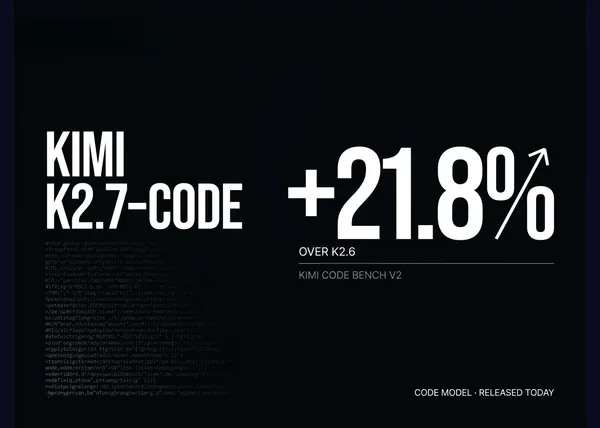
Moonshot AI Releases Kimi K2.7-Code: a Coding Model Reporting +21.8% on Kimi Code Bench v2 Over K2.6
Key Points
- 1Kimi K2.7-Code is Moonshot AI's new open-weight, agentic, coding-focused Mixture-of-Experts model, featuring 1T total parameters, a 256K token context window, and multi-modal capabilities.
- 2It demonstrates significant performance gains over K2.6 on coding benchmarks, including a 21.8% improvement on Kimi Code Bench v2, and reports approximately 30% lower reasoning-token usage for enhanced efficiency.
- 3Designed for long-horizon software engineering tasks like repo-scale refactoring and debugging, it offers an OpenAI-compatible API and self-hosting options, though it has fixed sampling parameters and substantial deployment requirements.
Kimi K2.7-Code, developed by Moonshot AI, is an agentic, coding-focused large language model designed for long-horizon software engineering tasks. It is distributed with open weights on Hugging Face under a Modified MIT license and is also accessible via the Kimi API and Kimi Code platform.
Architecturally, K2.7-Code is a Mixture-of-Experts (MoE) model, comprising a total of trillion parameters with billion parameters activated per token. Its MoE design incorporates experts, from which are selected per token, and is shared across tokens. The model features layers, including a single dense layer. For attention mechanisms, it utilizes Multi-Query Attention (MLA), and its feed-forward network employs the SwiGLU activation function. Additionally, it integrates a MoonViT vision encoder, contributing million parameters, to support image and video input. The model employs native INT4 quantization for efficient deployment. It boasts a substantial context window of tokens (). Operational constraints include a mandatory "thinking mode" for its agentic process, which cannot be disabled via API, and fixed sampling parameters (temperature , top\_p , n , penalties ). The default maximum output length is tokens. For self-hosting, compatibility is provided with vLLM, SGLang, and KTransformers, though the model's GB disk size positions it as a server-class deployment.
Moonshot AI's internal benchmarks indicate that K2.7-Code consistently outperforms its predecessor, K2.6, across various coding and agentic evaluation suites. Notably, it achieved a improvement on the Kimi Code Bench v2, increasing from to . It also showed significant gains on Program Bench (), MLS Bench Lite (), Kimi Claw 24/7 Bench (), MCP Atlas (), and MCP Mark Verified (). In comparisons against frontier models, K2.7-Code surpassed Claude Opus 4.8 on MCP Mark Verified ( vs. ) and approached GPT-5.5's performance on MLS Bench Lite ( vs. ). These benchmarks were conducted using Kimi Code CLI for K2.7-Code, Codex xhigh for GPT-5.5, and Claude Code xhigh for Opus 4.8.
A key cost optimization highlighted is a reported reduction in "reasoning-token" usage compared to K2.6, which translates to lower output-token costs, faster interactive CLI sessions, and an extended effective context window in multi-step agentic workflows.
Targeted use cases include repo-scale refactors where the agent can read files, edit across modules, and iteratively debug; code review by analyzing pull request diffs; complex tool-use workflows integrating Model Context Protocol (MCP) for CI checks, ticket updates, and file edits; and long-context analysis combining text, image, and video inputs for comprehensive prompt understanding.
The Kimi API is OpenAI-compatible, requiring adherence to the fixed sampling parameters and strict preservation of reasoning_content in multi-turn tool calls. Its competitive API pricing is tokens for cache-miss input and tokens for output, with a cached input rate of .
Strengths include its open weights, consistent performance gains over K2.6, competitive API pricing relative to closed-source models, and a strong showing on the MCP Mark Verified benchmark. Weaknesses noted are the reliance on first-party benchmarks, the inability to disable "thinking mode," locked sampling controls, the requirement to preserve reasoning_content for tool use, and the substantial size of the model weights for self-hosting.