Paper
This allows for flexible memory allocation, effectively eliminating external fragmentation and enabling high-efficiency batching.
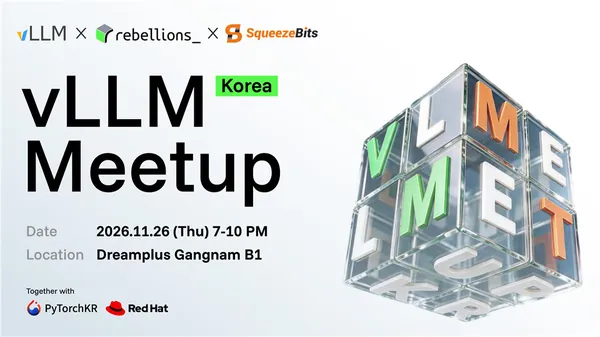
🇰🇷 2026 하반기 vLLM Korea Meetup에 초대합니다! 🚀
2026.11.03
·Web·by igor#LLM#React
Key Points
- 1The vLLM Korea community is hosting its second meetup of 2026 on November 26 at Dreamplus Gangnam.
- 2The event features two tracks covering both cutting-edge academic research and practical industry applications of vLLM technology.
- 3Attendance is free for all community members, though advance registration via the provided event link is required.
The provided text is an official announcement for the 3rd vLLM Korea Meetup, scheduled for the second half of 2026. The event serves as a collaborative platform for the vLLM community to share advancements in high-throughput Large Language Model (LLM) serving.
Event Overview
- Date: November 26, 2026 (Thursday), 19:00–22:00.
- Location: Dreamplus Gangnam, B1 Event Hall.
- Participation: Free of charge, with mandatory prior registration.
Core Objectives and Track Structure
The meetup is organized into two distinct tracks designed to bridge the gap between academic research and industrial implementation:- Research & Open-Source Track: Focuses on the architectural evolution of the vLLM engine, including the theoretical underpinnings of memory management techniques such as PagedAttention. Sessions aim to discuss the latest scholarly contributions, kernel optimizations (e.g., FlashAttention integration, speculative decoding advancements), and contributions to the open-source repository.
- Industrial Application Track: Provides insights into the practical deployment of vLLM in production environments. This includes optimizing throughput () and latency () under varying workloads, managing multi-tenant GPU utilization, and integrating vLLM with distributed infrastructure.
Technical Scope
The event addresses the fundamental vLLM paradigm, which optimizes the memory bottleneck in LLM serving. Specifically, the discussions revolve around:- PagedAttention Mechanism: A non-contiguous memory management technique inspired by virtual memory in operating systems, where the KV cache is partitioned into blocks:
This allows for flexible memory allocation, effectively eliminating external fragmentation and enabling high-efficiency batching.
- Throughput Optimization: Strategies for minimizing the request latency and maximizing the system's request handling capacity through efficient resource scheduling and GPU memory reclamation.
- Community Engagement: Fostering technical collaboration and knowledge transfer among engineers, researchers, and LLM practitioners currently utilizing the vLLM ecosystem.