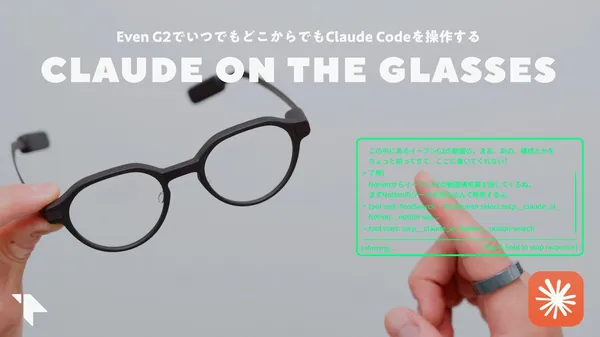
Video
Claude on Your Glasses — Working Anywhere with Even G2
2026.06.21
·YouTube·by igor#AI#LLM#Productivity#Remote Work#Smart Glasses
Key Points
- 1The Even G2 smart glasses utilize a "terminal mode" to interface with AI coding tools like Claude Code and Codex, enabling users to interact with their PC-based development environments through a heads-up display.
- 2By integrating with smartphone applications and VPN services like Tailscale, this technology allows for hands-free, remote control of local coding workflows from anywhere, overcoming the limitations of being tethered to a physical computer.
- 3This setup significantly improves productivity by enabling interactive AI communication, such as managing approvals and documenting tasks in Notion, without requiring the constant presence of a traditional monitor or keyboard.
The provided paper details a practical exploration of using the Even G2, a lightweight AI-powered smart glass by Even Realities, as an interface to remotely control local AI coding agents like Claude Code and Codex. The core of the utility lies in a feature called "Terminal Mode," which transforms the smart glass into a wearable display and interaction layer for a remote or local computer.
Core Methodology and Technical Implementation
The system functions as a bridge between the user's wearable hardware and a host machine running terminal-based AI agents.- Terminal Mode Integration: The Even G2 connects to a smartphone, which acts as a bridge to the "even-terminal" software running on a PC (e.g., a MacBook). This allows the glasses to project a real-time terminal interface, enabling the user to view outputs and interact with AI agents without requiring a physical monitor.
- Interaction Layer: The system utilizes an optional smart ring controller, which supports touch-based navigation (scrolling, tapping) and voice input. This facilitates a hands-free, interactive loop where the user can issue commands, receive feedback, and authorize file modifications through the glasses.
- Cross-Platform Connectivity: To overcome the limitation of being tethered to a local network, the author employs Tailscale, a zero-configuration VPN service based on the WireGuard protocol. By installing Tailscale on both the host computer and the mobile device, the system creates a virtual private mesh network. This allows the user to access the terminal interface from anywhere, provided the host machine is awake and connected to the internet.
- Workflow Automation: The setup allows for persistent AI sessions. The user can perform deep, multi-turn conversational tasks—such as updating Notion pages, drafting project structures, or triggering automated sub-tasks in applications like DaVinci Resolve—while away from the desk.
Technical Requirements
- Infrastructure: The system requires the
even-terminalCLI tool installed on the host and theEven Realitiesapp on a smartphone. Dependencies such as Node.js and npm are necessary for managing the terminal session. - Host Persistence: Because the AI agents run locally on the host machine, the host must be configured to prevent sleep modes to ensure continuous remote access via the glasses.
- Latency and Synchronization: The data stream is handled via the smartphone app, effectively mirroring the terminal's output buffer to the Even G2's monochromatic display.