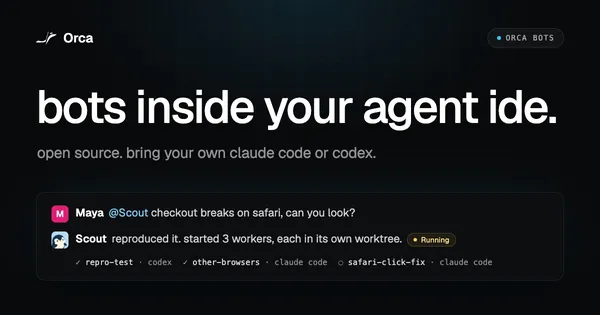
Bots inside your agent IDE.
Key Points
- 1Orca is an open-source, vendor-neutral platform that allows users to integrate their own AI agents, infrastructure, and tools into a unified automation workflow.
- 2By connecting with common enterprise platforms like Slack, GitHub, and Linear, the system enables users to trigger and manage agentic tasks from virtually anywhere.
- 3The platform distinguishes itself by allowing users to transition seamlessly from automated background tasks to their local IDE for manual intervention, ensuring full control and transparency.
Orca is an open-source, extensible agentic platform designed to bridge the gap between automated bot workflows and local development environments. Its core value proposition is the "Bring Your Own Everything" (BYOE) architecture, which allows users to integrate their existing LLM subscriptions (such as Claude Code or Codex), local compute infrastructure, and development toolchains without migrating data or incurring additional platform markups.
Core Methodology and Technical Architecture
The platform operates by decoupling the initiation of tasks from the execution environment. Rather than confining bot interaction to a chat interface, Orca orchestrates a distributed workflow:- Task Orchestration: Orca acts as an interface layer that monitors external triggers from Slack, Linear, GitHub, Gmail, Google Calendar, or custom Webhooks. Upon receiving a trigger, it coordinates an agentic worker.
- Execution Environment: The system spins up workers (using models like Claude Code or Codex) within isolated Git worktrees on the user's local machine or a specified Linux server. This enables the agent to operate directly on the codebase, utilize local terminal access, and execute "computer use" tasks.
- Connectivity via Orca Cloud: To ensure security without requiring open ports on the user's network, the system utilizes Orca Cloud as a relay for internal tool communication. This allows agents to reach internal repositories and tools while maintaining the security boundary of the local machine.
- Extensibility Framework: Orca integrates with the long tail of software tools through two primary methods:
- MCP (Model Context Protocol): Direct integration for structured tool interaction.
- Composio: An abstraction layer that facilitates connections to third-party services (e.g., Notion, Vercel, Datadog) using the user's own API keys.
- State Management: Agent memory and "soul" are stored as plain Markdown files. This design ensures human-readability and portability, allowing users to move configuration between systems or audit the agent’s decision-making process directly via file system inspection.
Interaction Model
The platform introduces a "handoff" mechanism where an agent initiates a task—such as bug reproduction, CI failure analysis, or PR review—and reports progress to the user. If the agent encounters a bottleneck or requires human input, it updates a centralized list accessible via the Orca mobile applications (iOS/Android).When the human decides to intervene, they can open the specific workspace context directly in their IDE. Because the agent executes in a standard Git worktree, the human is essentially "stepping in" to the same state the agent was inhabiting, effectively merging automated reasoning with manual development. By using an open-source (MIT) license and supporting cross-platform deployment (macOS, Windows, Linux), Orca avoids vendor lock-in and integrates into existing CI/CD pipelines and developer workflows as a modular extension rather than a monolithic service.