Service
GitHub - Mineru98/agent-file-lock: Lock files against coding agents with OS-level immutable flags
Mineru98
2026.09.02
·GitHub·by Mineru#Agent#Developer Tools#File Lock#Go#Security
Key Points
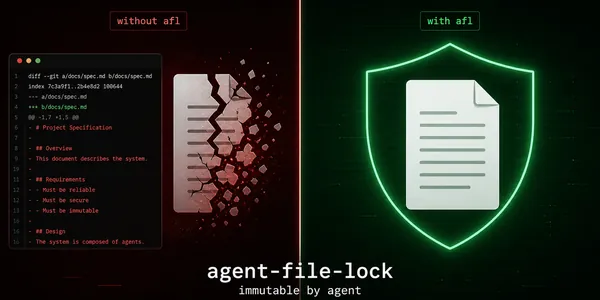
- 1`afl` (agent-file-lock) prevents coding agents from modifying or deleting critical files by applying kernel-level immutable and append-only flags to both target files and their parent directories.
- 2Unlike standard permissions, these kernel-enforced locks require root privileges to remove, effectively neutralizing common bypass techniques such as file renaming or temporary file replacement.
- 3The tool integrates with AI coding assistants through a "PreToolUse" hook, providing explicit, human-readable explanations to agents when a requested file modification is blocked.
agent-file-lock (afl) is a security utility designed to prevent automated coding agents and users from modifying, renaming, or deleting specific, sensitive files within a project. It leverages native kernel-level filesystem attributes to enforce immutability, ensuring that protections cannot be bypassed by standard file system operations or user-space tools.
Core Methodology and Technical Mechanisms
The tool operates by applying persistent filesystem flags that restrict inode modification at the OS level:
- Immutable Flags: On Linux,
aflutilizesFS_IMMUTABLE_FL(chattr +i), and on macOS, it uses the System Immutable flag (schg). These flags prevent any modification, deletion, or renaming of the file, even by the owner, without superuser (root) privileges. - Parent Guards: To prevent "path-swapping" attacks—where an agent might rename a parent directory to invalidate the lock on a child file—
aflenforces an append-only requirement on the entire directory tree leading to the project root. It appliesFS_APPEND_FLon Linux orSF_APPENDon macOS to parent directories. This ensures that while new files can be added, existing files and the directories themselves cannot be deleted or renamed. - Hook-Based Enforcement: Beyond kernel-level restrictions,
aflacts as a pre-tool execution guard for AI agents (e.g., Claude Code, Codex). It implements aPreToolUsehook that intercepts agent requests. When an agent attempts to perform a forbidden action, the hook provides a human-readable explanation ("The user has NOT authorized this agent to modify this file"), preventing the agent from interpreting the kernel'sEPERM(Operation not permitted) error as a generic system failure or a cue to attempt a workaround.
Functional Levels
The tool provides two security levels:- Strong (Default): Uses kernel-level immutable and append-only flags. This requires root/sudo to unlock and provides the highest level of security.
- User: Uses
chmod a-w(Linux) orUF_IMMUTABLE(macOS). These flags can be toggled by the user without root privileges, providing a lower security barrier but preventing accidental modifications.
Operational Workflow
- Initialization: Users define protected files in an
afl.yamlconfiguration. - Execution: The tool validates the system environment and mounts (e.g., checking if the filesystem supports
CAP_LINUX_IMMUTABLE) before locking. - Maintenance: Administrative tasks, such as
git pulloperations that modify protected files, are handled viaafl run. This command temporarily lifts the kernel locks and parent guards, executes the requested command, and automatically re-applies the protections upon completion. - Verification:
afl checkandafl statusare used to monitor for configuration drift, allowing the tool to be integrated into CI/CD pipelines or pre-commit hooks to ensure integrity.
The utility is built as a single static Go binary, requiring no runtime dependencies, and assumes that the final path component is handled via O_NOFOLLOW file descriptors to prevent symlink-based tampering during the locking process.