Blog
How Do LLMs Understand Images?
2026.07.04
·Web·by Leon#BLIP-2#Image Captioning#LLM#Multimodal AI#Vision Transformer
Key Points
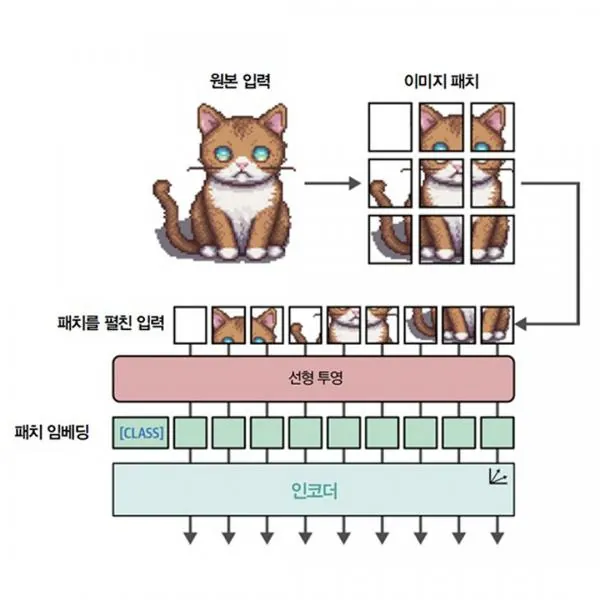
- 1Vision Transformers (ViT) enable multimodal capability by partitioning images into patches that are linearly embedded and processed as tokens, similar to text in standard transformer architectures.
- 2BLIP-2 bridges the gap between vision encoders and large language models (LLMs) by using a Q-Former module, which efficiently distills visual information into soft visual prompts for text-based reasoning.
- 3By leveraging pre-trained models and modular connections, frameworks like BLIP-2 and LLaVA allow for complex multimodal tasks such as image captioning without the prohibitive cost of training models from scratch.
This paper explores the architecture and mechanism behind Multimodal Large Language Models (MLLMs), focusing on how vision-language models bridge the gap between image data and text-based LLMs.
1. Vision Transformer (ViT)
The shift from Convolutional Neural Networks (CNNs) to Vision Transformers (ViT) represents a pivotal change in computer vision. ViT applies the Transformer encoder architecture—which achieved state-of-the-art results in NLP—to image data.- Tokenization via Patching: Since images lack discrete "words," ViT divides an image into a series of fixed-size patches (typically pixels).
- Linear Projection: Each patch is flattened and linearly embedded into a numerical vector, functioning analogous to word tokens.
- Processing: Once converted into embeddings, these patches are treated as a sequence, enabling the model to utilize standard self-attention mechanisms to understand spatial relationships and global context, effectively allowing the model to "see."
2. BLIP-2: Bridging the Modality Gap
BLIP-2 addresses the computational infeasibility of training massive multimodal models from scratch by introducing a Querying Transformer (Q-Former) to bridge pre-trained vision encoders (like ViT) and pre-trained LLMs.- Q-Former Architecture: It consists of two sub-modules that share self-attention layers: a vision-side transformer that interacts with the (frozen) vision encoder, and a language-side transformer that interacts with the (frozen) LLM.
- Training Phases:
- Phase 1 (Representation Learning): The Q-Former is trained using image-caption pairs through three optimization objectives:
- Image-Text Contrastive Learning: Aligning image and text embeddings in a shared space.
- Image-Text Matching: Binary classification of whether an image-text pair is positive or negative.
- Image-Grounded Text Generation: Generating captions based on visual input.
- Phase 2 (LLM Integration): The learned visual embeddings are transformed via a linear projection layer into "soft visual prompts." These act as a conditional context for the LLM, effectively allowing the text-only model to interpret the visual information extracted by the Q-Former.
- Phase 1 (Representation Learning): The Q-Former is trained using image-caption pairs through three optimization objectives:
3. Applications and Ecosystem
The paper highlights that this modular approach—using a frozen vision encoder and a frozen LLM connected by a trainable bridge—has become the standard for modern MLLMs such as LLaVA and Idefics 2.The practical implementation involves:
- Preprocessing: Converting raw images into the specific pixel format required by the vision encoder.
- Encoding: Extracting visual features through the ViT.
- Prompting: Projecting those features into the LLM’s input space to generate text, such as descriptive captions, based on the visual context.
By leveraging pre-trained components, this architecture enables the creation of powerful multimodal systems without the extreme computational burden of training from scratch.