Paper
Scientific computing in the age of agentic AI
2026.07.29
·Service·by JunhaRyu#Agent AI#AI Agents#Research#Scientific Computing#Software Development
Key Points
- 1Scientific computing is currently hindered by fragile, poorly maintained software, but AI coding agents are significantly accelerating development by automating tedious implementation tasks.
- 2Researchers are shifting from direct coding to roles focused on verification and orchestration, as they must carefully validate agent-generated outputs against scientific benchmarks to ensure correctness.
- 3While agents improve development velocity, the long-term success of these tools depends on human-led stewardship to prevent code fragmentation and ensure reliable, sustainable scientific infrastructure.
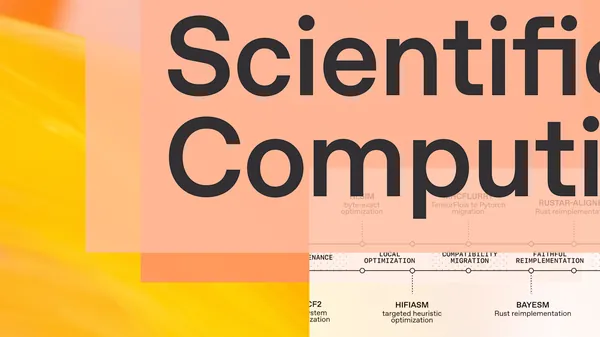
This report examines the integration of coding agents—specifically utilizing models like Codex and Claude Code—into the scientific computing lifecycle, focusing on how these tools address the historical "maintenance gap" in research software. In academic and data-rich fields like genomics, scientific software often suffers from fragility and poor long-term support because it originates from resource-constrained academic teams. The report evaluates eight projects to demonstrate how agents mitigate engineering constraints, allowing researchers to shift their focus from manual implementation to verification and high-level orchestration.
Core Methodology and Technical Application
The projects implemented by these teams utilized coding agents to perform a variety of structural and functional upgrades, ranging from routine maintenance and dependency management to complex architecture overhauls, such as migrating codebases to be GPU-native. The methodology for these deployments consistently followed an iterative, feedback-driven process:- Task Decomposition: Instead of employing one-shot prompting, researchers broke down broad scientific objectives into modular, well-scoped engineering tasks. This allowed agents to operate within narrow contexts, reducing the surface area for logic errors.
- Verification and Parity Testing: Because agents often exhibit high confidence even when producing incorrect code, the methodology emphasized rigorous validation. Effective strategies included:
- Exact output agreement: Ensuring the agent-generated output matched legacy outputs given identical inputs ().
- Statistical behavior modeling: Verifying that the output adhered to expected probability distributions or statistical constraints characteristic of the scientific domain.
- Simulated data benchmarking: Comparing results against established "ground truth" values generated in controlled, simulated environments.
- Iterative Refinement: The "last mile" of implementation—resolving edge cases and subtle numerical discrepancies—required the most human oversight. Researchers used intermediate benchmarks as a feedback loop, continuously re-prompting and refining agent outputs until the software reached scientific parity with existing tools.