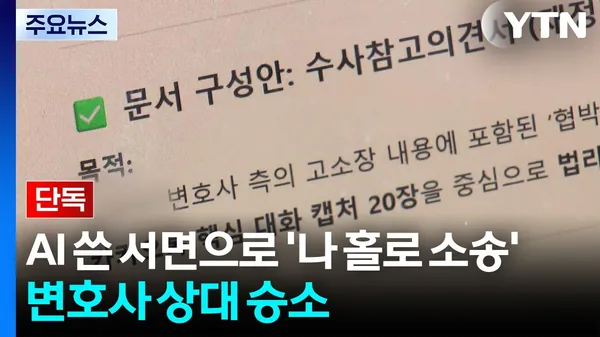
[Exclusive] Winning a lawsuit against a lawyer acting 'pro se' using AI-drafted documents / YTN
Key Points
- 1A recent case in Korea demonstrated AI's disruptive potential in the legal sector, as a non-expert successfully won both civil and criminal disputes against a professional lawyer by exclusively utilizing artificial intelligence.
- 2Facing a lawsuit from his former legal counsel and unable to secure new representation, the individual self-represented, employing AI for comprehensive litigation support from complaint analysis to document drafting.
- 3The AI proved instrumental by identifying critical errors in the lawyer's documents, such as incorrect dates and missing signatures, ultimately leading to the non-expert's unprecedented complete victory.
This paper details a groundbreaking case where a non-expert successfully navigated and won multiple legal disputes against a professional lawyer by leveraging artificial intelligence (AI) tools. The case involved Mr. Park Jang-ho, who, after terminating his contract with Lawyer AC due to a disagreement over an opinion letter, faced retaliatory lawsuits: a civil claim for 5.1 million Korean Won in unpaid fees from Lawyer AC's firm and a criminal complaint from Lawyer AC alleging extortion. Unable to secure representation from other lawyers, Mr. Park proceeded with "do-it-yourself" litigation.
The outcome was a complete victory for Mr. Park: the police ruled "no charges" in the criminal case, and he ultimately prevailed in the civil lawsuit. This unprecedented success was attributed entirely to the strategic application of AI.
The core methodology employed involved an AI system that provided comprehensive support throughout the litigation process. Specifically, the AI system demonstrated advanced capabilities in several key areas:
- Document Analysis: It performed sophisticated analysis of complex legal documents, including the initial criminal complaint (고소장). This suggests capabilities akin to advanced natural language processing (NLP) for semantic understanding, named entity recognition (NER) to extract critical information, and potentially legal ontology mapping.
- Legal Review and Reasoning: The AI conducted thorough legal reviews (법리 검토), indicating its ability to interpret legal principles, identify relevant statutes or precedents, and assess the legal strength of arguments. This could involve rule-based systems, case-based reasoning (CBR), or even predictive analytics based on historical legal data.
- Document Generation and Assistance: It assisted in the drafting of various legal documents (각종 서면 작성), implying text generation capabilities or sophisticated template filling, ensuring adherence to legal formalities and precision in language.
- Strategic Support: A critical feature was its ability to generate customized response strategies (맞춤형 대응 전략) in real-time simply by inputting the opposing party's complaint. This suggests a decision support system that analyzes adversarial positions, identifies weaknesses, and recommends counter-arguments or procedural actions.
- Error Detection and Anomaly Identification: The most impactful contribution of the AI was its precise identification of critical errors made by the opposing lawyer. Specifically, the AI detected:
- An incorrectly dated transcript (날짜가 잘못 기재된 녹취록) within an opinion letter authored by Lawyer AC.
- Omissions of dates and signatures (날짜와 서명 누락) in contractual documents.
This case, despite being a small claims matter, is significant as the first confirmed instance of a non-legal professional successfully defeating a seasoned lawyer in court using AI, thereby challenging the conventional necessity of human legal experts for basic litigation.