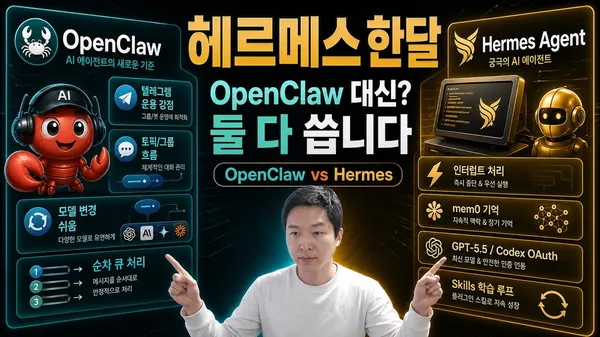
I've been using Hermes Agent for a month, which is said to be hotter than OpenClaw (OpenClaw vs H...
Key Points
- 1The speaker evaluates Hermes Agent and OpenKlo, highlighting Hermes's strengths in skill accumulation, long-term memory integration, and dynamic task interruption for developer-centric work.
- 2OpenKlo is preferred for its robust personal assistant capabilities, excelling in daily routine management and effective handling of Telegram group and topic contexts.
- 3The speaker concludes that a role-division strategy is optimal, utilizing OpenKlo for established daily operations and Hermes for skill-building and experimental tasks, sometimes delegating to OpenKlo to leverage both agents' unique strengths.
The paper details the author's journey and current strategy in utilizing AI agents, specifically comparing and contrasting Hermes Agent with OpenKlo. Initially, the author attempted to fully transition to Hermes due to its perceived advantages, but ultimately settled on a dual-agent system, leveraging the strengths of both.
Hermes Agent: Core Features and Methodology
Hermes Agent is described as an open-source AI agent developed by News Research. Its core design philosophy centers around evolving intelligence: it resides on a server, accumulates memory, develops skills, and progressively becomes smarter over time.
- Distinction from OpenKlo: While both Hermes and OpenKlo can be installed on a server and interact via messengers (e.g., Telegram) to perform tasks like file manipulation, terminal commands, and browser operations, their fundamental approaches differ. OpenKlo functions more as a general personal assistant handling routine tasks (e.g., email drafting, YouTube script generation, investment briefings). In contrast, Hermes exhibits a more developer-centric design, emphasizing the systematic accumulation of knowledge and reusability of solutions.
- Learning Loop and Skill Accumulation (Compound Engineering Philosophy): This is presented as Hermes's most significant advantage. A common frustration with AI agents is their tendency to repeat past mistakes or "reinvent the wheel." Hermes addresses this through a "learning loop" mechanism that the author likens to a "compound engineering" philosophy. When Hermes successfully resolves a complex problem, the solution is explicitly documented and saved as a "skill." For subsequent, similar tasks, Hermes actively references these pre-existing skills through a "skill view" mechanism. This means that instead of starting from scratch, Hermes retrieves and applies previously learned methods, leading to cumulative improvement and reduced redundancy in effort. The paper posits that Hermes is "born" with this inherent structural advantage for skill creation and reuse, unlike OpenKlo which would require significant structural modification to achieve similar results.
- Memory Integration with Memzero: To enhance long-term memory capabilities, the author integrates Memzero with Hermes. Memzero acts as an external long-term memory module, allowing Hermes to store and retrieve past interactions and learned information efficiently. While Honcho, another memory modeling tool, was considered, technical errors prevented its implementation, leading to the sole use of Memzero.
- Interrupt Functionality: Unlike OpenKlo, which processes commands sequentially (like a queue, ), Hermes possesses an "interrupt" feature. This allows the user to interject new instructions while a task is in progress. Hermes then dynamically integrates these new instructions with the ongoing task, processing them concurrently (). This provides a more fluid and natural interaction, akin to human collaboration where instructions can be adjusted mid-task.
- Flexible Model Selection: Both Hermes and OpenKlo offer broad compatibility with various large language models (LLMs) and APIs, including GPT, Claude, and local VLMs. The author notes a significant reduction in operational costs by leveraging services that offer GPT-3.5 and Codec models under an OEM (Original Equipment Manufacturer) or similar cost-effective API arrangement, allowing extensive use without significant per-token billing concerns.
Limitations of Hermes and Continued Use of OpenKlo
Despite Hermes's strengths, it does not fully replace OpenKlo for the author, primarily due to two factors:
- Telegram Group and Topic Integration: Hermes currently struggles with the nuanced handling of Telegram group topics and contexts, which OpenKlo manages seamlessly. This can lead to difficulties in context routing and smooth communication, especially when multiple AI bots are present in a single group, hindering effective collaborative work division among agents.
- Migration Imperfection: While Hermes offers a migration feature from OpenKlo, it does not fully transfer accumulated context. The established habits, specific conversational flows, and deeply integrated automations within OpenKlo, honed over a long period of use, are difficult to replicate perfectly in Hermes. This highlights that an AI assistant's value extends beyond mere feature lists to its deep understanding of the user's personal context and preferences.
Current Role Division Strategy
The author concludes that the optimal approach is not a "switch" but a "division of labor." Both agents, though utilizing similar underlying LLMs (e.g., GPT-3.5 and Codec) and thus possessing comparable core intelligence, excel in different operational paradigms due to their inherent structural designs.
- OpenKlo: Serves as the primary "daily assistant," handling Telegram-based automations, leveraging its strong context management within topics, and managing existing tasks that have accumulated significant conversational history and automation routines. Its strength lies in its ability to effectively control the browser and external computing nodes.
- Hermes: Is assigned tasks that benefit from its specialized "developer-like" capabilities:
- Repetitive tasks suitable for "skill" creation and reuse.
- Experimental and research-oriented tasks where systematic knowledge accumulation is beneficial.
- Tasks requiring robust long-term memory via Memzero integration.
- Session searching and the accumulation of operational methodologies.
This dual-agent system allows the author to leverage the unique "genetic" advantages of each agent: OpenKlo for its contextual fluency and seamless daily assistance, and Hermes for its structured learning, skill development, and robust long-term memory, ensuring maximum efficiency and adaptability in AI-assisted workflows. The paper advocates for a future where users employ multiple specialized AI agents rather than a single general-purpose one, segmenting tasks by agent capability, and even by cost (e.g., expensive vs. cheap computational "brains").