Service
GitHub - tt-a1i/archify: Agent skill for beautiful, verifiable architecture, workflow, sequence, data-flow, and lifecycle diagrams—self-contained HTML with motion and crisp export.
tt-a1i
2026.09.04
·GitHub·by Mineru#Agent Skill#Architecture Diagrams#Code Visualization#Interactive Diagrams#System Mapping
Key Points
- 1Archify is a Node.js-based system that enables AI agents to compile typed JSON architectural descriptions into interactive, validated HTML/SVG diagrams.
- 2The tool ensures technical accuracy through deterministic compilation, atomic validation of structure and routes, and the ability to compare architecture snapshots for design reviews.
- 3It supports multiple diagram types and deployment profiles while remaining portable, self-contained, and integrated into common AI developer workflows via CLI and agent plugins.
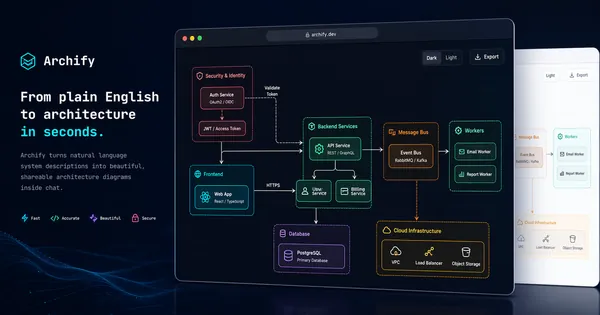
Archify is a specialized Node.js-based system designed to transform technical system descriptions or codebase analyses into interactive, validated, and polished architecture diagrams. Unlike general-purpose diagramming tools, it operates as an agent-aware skill for environments like Cursor, Claude Code, and the Codex CLI, focusing on deterministic rendering and rigorous structural validation rather than free-form editing.
Core Methodology
The Archify workflow centers on a strict pipeline: Generate, Validate, Preview, and Deliver.- Generation: Agents translate natural language system descriptions into a typed JSON Intermediate Representation (IR). This IR mandates a structured schema that explicitly defines system components, relationships, and boundaries.
- Validation: Before any visual output is produced, the system subjects the IR to a series of deterministic checks. These rules verify structural integrity, schema compliance, layout feasibility, and clearance for labels and routes. If the IR is invalid, the system returns machine-readable error diagnostics containing specific, actionable repair instructions rather than unstructured stack traces.
- Rendering: Upon successful validation, the system compiles the JSON into self-contained HTML/SVG artifacts. Archify emphasizes "layout judgment" over generic auto-layout algorithms, ensuring the agent provides hierarchical clarity. The renderer supports five diagram types—Architecture, Workflow, Sequence, Data Flow, and Lifecycle—each tailored to specific technical visualization needs.
- Delivery and Iteration: The system maintains a "last-known-good" artifact approach. An optional desktop preview loop watches the source JSON, refreshing only when a new candidate passes all gates. This ensures that the generated visual representation remains consistently truthful to the authored IR.
Technical Capabilities
- Architecture Delta: A key feature for PR reviews, this allows for the programmatic comparison of two snapshots (Base vs. Head). It generates a "Delta" view that highlights added, removed, changed, moved, or rerouted architectural facts, providing a formal machine-readable receipt of the architectural changes.
- Deterministic Artifacts: All exports (PNG, SVG, WebM) are generated from a single, verified source. This ensures reproducibility and allows for the creation of canonical "Share Cards" (1200×630) that maintain contextual integrity.
- Interactive Probing: The viewer supports high-fidelity interactions such as tracing upstream/downstream reach, probing directed routes, comparing semantic roles, and playing finite guided stories. These interactions are strictly grounded in the authored topology, preventing the introduction of hallucinated runtime paths.
- Deployment-Ownership Profiling: The system includes a framework for mapping deployment boundaries, such as region placement and private database scopes. This feature fails closed if required architectural facts are missing, emphasizing verifiable proof over implicit assumptions.