GitHub - Yeachan-Heo/gajae-code: Gajae Code MVP
Key Points
- 1Gajae-Code is an experimental, external coding-agent harness designed to provide a structured workflow through deep interviewing, implementation planning, and evidence-based goal tracking.
- 2The platform enhances developer productivity by supporting tmux-backed parallel execution, isolated worktrees, and optional desktop-control tools while remaining compatible with existing coding agents.
- 3It features a configure-once notifications SDK and an interactive TUI to facilitate seamless communication across various messaging platforms and local tools without requiring terminal scraping.
Gajae-Code (gjc) is an experimental, external coding-agent harness designed to provide a structured, durable execution surface for software development tasks. Unlike plugins for existing tools, it functions as an autonomous, persistent runner that utilizes a specific workflow methodology to enhance task reliability and reproducibility.
Core Methodology and Architecture
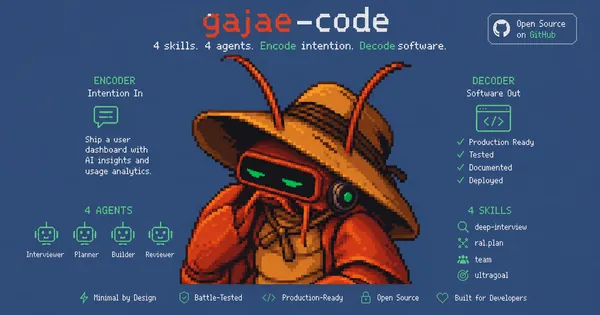
Gajae-Code emphasizes a "plan-before-mutation" paradigm, enforcing a rigorous sequence that minimizes guesswork. The core workflow involves four distinct skills:- deep-interview: A process for clarifying ambiguous user requirements.
- ralplan: An architectural critique phase that validates implementation plans before code is modified.
- ultragoal: A state-tracking system for execution, revisions, and verification that provides objective evidence of task completion.
- team: A facility for coordinating parallel tasks via tmux-backed workers.
Technically, the architecture is built around a persistent CLI that supports isolated worktrees, allowing users to perform risky or complex refactors without disturbing their primary development environment. It employs a "loopback WebSocket discovery" mechanism to facilitate integration with mobile apps, Slack, Discord, or Telegram, enabling a non-terminal-scraping approach to notifications and user-agent interaction.
Advanced Features and Integration
- Research & Desktop Control: The system includes an opt-in research mode (rlm) that functions like a Jupyter notebook for the agent loop, leveraging a shared Python kernel and web search tools to generate structured
report.mdfiles. An experimental "computer-use" surface provides the agent with native screenshot and input bindings, allowing it to drive local desktop applications. - Extensibility & RPC: Gajae-Code is designed for interoperability rather than encapsulation. It supports a gRPC-based external controller model, allowing external bots or scripts to drive the agent through defined contracts rather than screen scraping.
- TUI & Identity: The interface features a theme-aware terminal user interface (TUI) that defaults to "red-claw" for dark mode and "blue-crab" for light mode, with secondary compatibility themes that mimic the visual style of tools like Claude Code and Codex to minimize cognitive friction during migration.
- Verification: The system includes a benchmarking tool,
geobench, specifically for evaluating agent performance metrics such as hit rate, Mean Reciprocal Rank (MRR), and citation accuracy, providing a standardized way to measure the efficacy of different LLM provider configurations.
Technical Implementation
The system relies on a bundled set of native bindings (@gajae-code/natives) and supports a tmux-centric execution model to manage stateful worker sessions. It implements a provider retry logic system defined within ~/.gjc/config.yml that governs request and stream budgets to ensure robust handling of transient failures, while enforcing "fail-fast" behavior for authentication errors or context overflows. The project is primarily developed using Bun and TypeScript, with a focus on persistent session ownership to prevent concurrency conflicts in environments like Telegram.