Kakao Releases 4 Lightweight Language Models as Open Source
News

Kakao Releases 4 Lightweight Language Models as Open Source

@newspim
2026.07.28
·Web·by Homin.Lee
#AI#Korean#LLM#Open Source#SLM

Key Points

  • 1Kakao has released four open-source lightweight language models (SLMs) from the 'Kanana-2' series, optimized for on-device operation on smartphones and other hardware.
  • 2By utilizing a specialized Korean tokenizer, these models improve language processing efficiency by over 30% and feature a sliding window attention structure that reduces memory usage by up to 72.7%.
  • 3The models are available under the 'Kanana Open License' for commercial use and demonstrate competitive performance against global alternatives like Qwen and Gemma in various tasks.

Kakao has officially released its "Kanana-2" series, a collection of four Small Language Models (SLMs) available as open-source under the "Kanana Open License," which permits commercial use. The models, available in 1.3B and 3B parameter configurations (both base and instruct versions), are specifically engineered for on-device deployment, enabling high-performance AI execution on hardware with limited memory resources, such as smartphones.

Core Methodology and Technical Enhancements:

  1. Korean-Specific Tokenizer Optimization:
The performance gain is fundamentally anchored in a proprietary Korean-optimized tokenizer. By refining the segmentation process of Korean text, the tokenizer reduces the number of tokens required to represent a given sentence. This directly correlates to increased computational efficiency, resulting in a performance improvement of over 30% in Korean language processing compared to conventional models.

  1. Memory Management via Sliding Window Attention:
To address the constraints of on-device environments, the architecture incorporates a "Sliding Window Attention" mechanism. This structure allows the model to handle long-context inputs—up to 32,000 tokens (approximately 24,000 words)—without proportional memory scaling. Technically, this significantly reduces memory consumption by up to 72.7% during long-sequence inference, maintaining stability in resource-constrained environments.

  1. Comparative Performance:
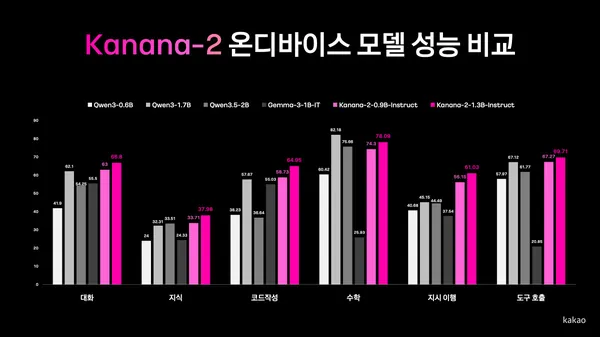
The Kanana-2 series is designed to compete with established global SLMs such as Qwen and Gemma. Empirical testing suggests that the 1.3B and 3B versions demonstrate parity in critical domains, including conversational ability, domain-specific knowledge, code generation, and mathematical reasoning.

  1. Strategic Deployment:
Kakao has already integrated these SLM architectures into its internal ecosystem, including "Kanana in KakaoTalk," automated chat and call summarization features, and the "AI National Secretary" service. By open-sourcing these models, Kakao aims to bolster the domestic AI ecosystem, providing developers, startups, and research institutions with a robust framework for building proprietary AI services that balance cloud-based large-scale processing with efficient on-device execution.