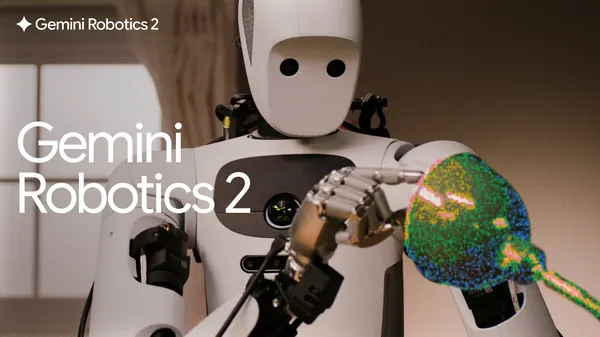
Gemini Robotics 2 brings whole body intelligence to robots
Key Points
- 1Gemini Robotics 2 introduces a generalist model designed to handle the complex, unstructured nature of physical environments through advanced whole-body control.
- 2The system excels in dexterous manipulation, enabling robots to perform intricate tasks like screwing in lightbulbs and managing complex objects that were previously considered impossible.
- 3By leveraging decentralized reasoning, the model allows multiple robots to collaborate and coordinate their movements simultaneously to accomplish shared objectives.
The paper introduces Gemini Robotics 2, a foundational AI model architecture designed to advance the field of humanoid robotics from specialized, task-specific performance toward true general-purpose intelligence. The core objective is to overcome the "messy complexity" of human environments by replacing traditional task-specific programming with an end-to-end neural network that serves as the "brain" for various robotic embodiments, specifically the Sharpa hand and the Duo humanoid platform.
Core Methodology and Technical Focus
The methodology centers on integrating three technical advancements into a unified neural control stack:
1. Whole-Body Control (WBC)
Unlike traditional robotics that decouple motion planning from control, the model treats the robot as a holistic system. It manages high-dimensional coordination by simultaneously calculating control signals for a multitude of actuators. The model must process the state vector at time to output an action vector , where encompasses all joints across the robot’s kinematic chain, effectively solving for:
where represents the policy network with parameters , and is the high-level task goal. This allows for fluid movement that mirrors human coordination rather than rigid, segmented trajectories.
2. Dexterous Manipulation
The model addresses the complexities of fine-motor control, such as screwing in a lightbulb or manipulating unstructured objects like trash bags. This involves controlling 22 separate joints within a single hand. By training on diverse manipulation datasets, the model learns to map tactile and visual feedback to precise motor torques, bypassing the limitations of classic pick-and-place algorithms.
3. Multi-Robot Orchestration and Reasoning
A significant innovation in Gemini Robotics 2 is the deployment of decentralized agents that exhibit emergent cooperation. Rather than using a single centralized master controller, each robot runs an independent copy of the neural stack. These agents achieve synchronization through high-level reasoning and environmental observation. Communication between robots is implicit, mediated by the shared reality of the workspace; each robot maintains its own policy such that:
where represents the reasoning function that interprets the scene state to ensure collaborative task completion. This allows the robots to dynamically adapt to the physical presence and actions of other agents in real-time, enabling simultaneous, complex task execution.
In conclusion, the paper frames AI as the "missing piece" in robotics, moving the field toward a future where a single, generalized model can navigate and manipulate the human-centric world through intuitive, real-time reasoning and whole-body coordination.