Paper page - TradingAgents: Multi-Agents LLM Financial Trading Framework
Key Points
- 1TradingAgents proposes a novel multi-agent LLM framework for financial trading that addresses the underexplored potential of collaborative dynamics found in real-world trading firms.
- 2This framework simulates a dynamic trading environment by assigning specialized roles to LLM-powered agents, including fundamental analysts, sentiment analysts, technical analysts, and a risk management team.
- 3Extensive experiments reveal TradingAgents' significant superiority over baseline models, demonstrating notable improvements in cumulative returns, Sharpe ratio, and maximum drawdown.
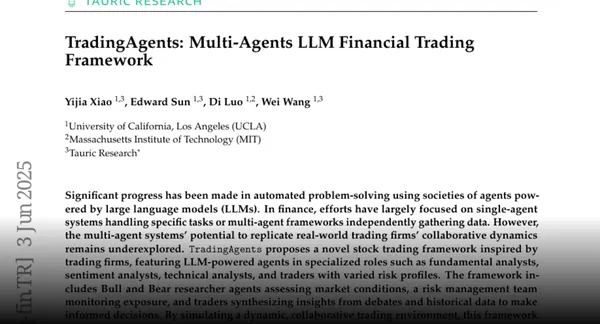
The paper "TradingAgents: Multi-Agents LLM Financial Trading Framework" introduces a novel multi-agent system designed to simulate and enhance automated stock trading by replicating the collaborative dynamics observed within real-world trading firms. While existing LLM-powered financial systems predominantly rely on single-agent models for specific tasks or multi-agent frameworks with independent data collection, TradingAgents explores the underexplored potential of a truly collaborative agent society.
The core methodology of TradingAgents is an architecturally sophisticated framework comprising specialized Large Language Model (LLM)-powered agents, each assuming a distinct role akin to human professionals within a trading firm. These roles include:
- Fundamental Analysts: Responsible for evaluating the intrinsic value of assets based on economic, industry, and company-specific data.
- Sentiment Analysts: Tasked with processing and interpreting market sentiment from diverse sources (e.g., news, social media) to gauge market mood and potential shifts.
- Technical Analysts: Focusing on historical price and volume data to identify patterns and predict future price movements using various technical indicators.
- Bull Researcher Agents: Analyzing market conditions with an optimistic bias, seeking opportunities for upward price trends.
- Bear Researcher Agents: Analyzing market conditions with a pessimistic bias, identifying potential downward price trends and risks.
- Risk Management Team: Continuously monitoring and managing the overall portfolio exposure, ensuring adherence to predefined risk tolerance levels, and mitigating potential losses.
- Traders (with varied risk profiles): The decision-making entities responsible for executing trades. They synthesize and weigh the diverse insights, analyses, and debates from the specialized analytical and research agents. The paper implies these traders may be configured with different risk appetites (e.g., conservative, moderate, aggressive), allowing for diversified trading strategies within the framework.
The collaborative mechanism is central to the framework's efficacy. Unlike independent agents, the specialized agents within TradingAgents engage in a dynamic, collaborative environment, where insights are debated, reconciled, and synthesized. For instance, Bull and Bear researchers might present conflicting views on market direction, prompting a deliberative process that the traders then use to formulate their strategies. This integrated approach ensures that trading decisions are informed by a comprehensive, multi-faceted analysis, mirroring the complex decision-making processes in human-operated trading desks. The LLMs empower each agent to understand complex financial data, generate reasoned analyses, and participate in structured communication and debate, ultimately leading to more robust trading signals.
Extensive experiments validate the framework's superior performance compared to traditional baseline models. TradingAgents demonstrates notable improvements across key financial metrics, including:
- Cumulative Returns: The total return generated over a period, indicating higher profitability.
- Sharpe Ratio (): A measure of risk-adjusted return, where is the expected portfolio return, is the risk-free rate, and is the portfolio's standard deviation (volatility). A higher Sharpe Ratio indicates better returns for a given level of risk.
- Maximum Drawdown: The largest peak-to-trough decline in the value of an investment over a specific period, used as a measure of downside risk. TradingAgents achieved a reduced maximum drawdown, signifying improved risk management.
The significant enhancements in these metrics underscore the potential of multi-agent LLM frameworks in financial trading, particularly when designed to mimic real-world organizational structures and collaborative decision-making processes. The open-source availability of TradingAgents at https://github.com/TauricResearch/TradingAgents facilitates further research and replication.