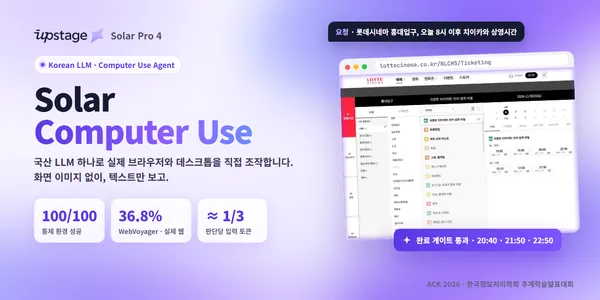
GitHub - jaemin-jo/solar-computer-use: 국산 LLM Upstage Solar Pro 4 하나로 실제 브라우저·데스크톱을 조작하는 컴퓨터 유즈 에이전트 · ACK 2026
Key Points
- 1"Solar Computer Use" is a computer-use agent that leverages the Upstage Solar Pro 4 LLM to perform web and desktop automation tasks using only text-based input instead of screenshots.
- 2The project introduces four specialized execution algorithms—DOT, BASE, STAR, and GATE—to optimize decision-making efficiency, reduce token consumption by up to three times, and ensure grounded task completion.
- 3Empirical testing demonstrates a 100% success rate in controlled environments and achieves 92% of GPT-4's performance on WebVoyager tasks, proving that a specialized Korean model can effectively execute complex agentic workflows.
Summary: Solar Computer Use
Solar Computer Use is a computer-use agent framework designed to enable autonomous browser and desktop operation using only the Korean Large Language Model (LLM), Upstage Solar Pro 4. It addresses the lack of specialized domestic AI agents capable of navigating Korean digital infrastructure (e.g., government portals, banking services) by leveraging a single model architecture without reliance on external proprietary models.
#### Core Methodology: The Four-Algorithm Execution Loop
The framework optimizes decision-making by implementing four distinct, synergistic algorithms that structure how Solar Pro 4 interacts with the environment:
- DOT (Delta Observation with stable Tags): Rather than passing entire screenshots or redundant UI snapshots, this mechanism assigns unique tags to screen elements. From the second observation onward, the system only transmits the "delta" (the changed parts of the screen), significantly reducing the input token volume and focusing the model on active state updates.
- BASE (Batched Actions with Stop on Emergence): This algorithm allows the model to output a sequence of actions to be executed in a batch. To maintain robustness, it incorporates an emergency stop trigger: if the execution environment detects the appearance of new input fields, dropdown menus, or modal windows not anticipated in the previous state, the batch is immediately halted, and the model re-evaluates the new state.
- STAR (STate-Action Repeat guard): An anti-loop mechanism that monitors the history of the execution to prevent the agent from repeatedly performing identical actions in the same state, which is a common failure mode in autonomous web agents.
- GATE (Grounded Answer & Task-condition Evaluation): A post-action validation layer that replaces naive "task completion" claims. The host system cross-references the model's reported result against verified environmental evidence and specific task constraints (e.g., temporal conditions like "after 8:00 PM"). If the gate rejects the completion, it provides the model with the specific reason for failure, forcing a refined response.
#### Technical Performance and Efficiency
The research demonstrates that execution structure is as critical as model performance. Key findings include:
- Task Accuracy: The framework achieved a 100/100 success rate in a controlled environment across 5 distinct, repetitive tasks (including dynamic form filling and multi-step data retrieval).
- WebVoyager Benchmark: When tested against the WebVoyager dataset without image inputs, Solar Pro 4 achieved 36.8% task success, reaching approximately 92% of the performance of GPT-4 using text-only inputs.
- Token Optimization: By using the delta-based observation strategy (DOT), the agent reduces token consumption to roughly of conventional computer-use agents, as it maintains only the most recent two full-context snapshots while streaming only changes.
- Logical Verification: Unlike agents that trust the model's self-assessment, the system utilizes programmatic verification (e.g., cross-referencing official API values or specific UI state conditions) to ensure the groundedness of the agent’s actions.
This work establishes a high-efficiency paradigm for localized AI agents, proving that specialized execution logic can compensate for model scale, enabling complex tasks on real-world Korean web interfaces without the need for multimodal vision models or high-latency external model calls.