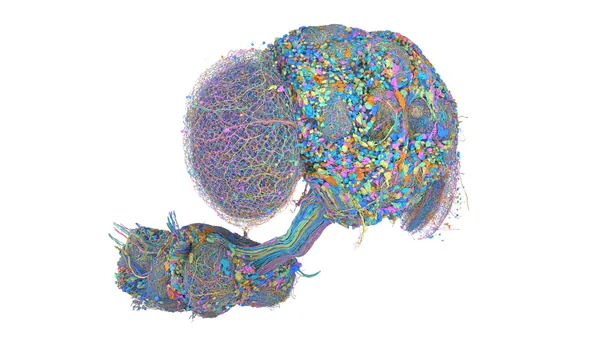
5 amazing visuals show how the male fruit fly’s brain map is advancing neuroscience
Key Points
- 1Researchers from HHMI Janelia and Google Research have generated the first complete neural map of an adult male fruit fly, documenting over 166,000 neurons and nearly 12,000 distinct cell types.
- 2By utilizing AI to reconstruct millions of 2D images into a detailed 3D model, the project provides a comprehensive resource for understanding how sensory inputs translate into complex social behaviors and movement.
- 3This study highlights key structural differences between male and female fly brains and serves as a foundational milestone for the field of connectomics and future neuroscience research.
A multi-institutional collaboration led by HHMI Janelia Research Campus and Google Research has achieved a milestone in connectomics by completing the first comprehensive neural map of the adult male fruit fly (*Drosophila melanogaster*) brain and ventral nerve cord. This project provides a foundational dataset for understanding the structural basis of behavior, sensory processing, and sex-specific neurobiology.
Core Methodology: Scaling Connectomics via AI
The construction of this map represents a significant advancement in the field of connectomics—the systematic mapping of neural connections. The methodology relied on the following technical processes:- Sample Preparation and Imaging: The researchers utilized thin-sectioning techniques to segment the fruit fly brain and body, capturing millions of high-resolution 2D images.
- Computational Reconstruction: The transition from 2D imagery to 3D neural models was achieved through advanced artificial intelligence and computer vision algorithms. These tools were required to stitch millions of microscopic images together, reconstruct the complex morphologies of over 166,000 neurons, and facilitate the classification of nearly 11,700 distinct cell types.
- Connectomic Analysis: By establishing the 3D topology of these neurons, the team was able to map the synaptic pathways. This allows for the study of how information flows from sensory organs—such as the compound eyes and the proboscis—through intermediate processing circuits to motor neurons that dictate behavior.
Scientific Findings and Implications
- Neural Complexity: The map documents 166,000 neurons and 11,691 cell types, categorized based on morphology, function, and gene expression.
- Sexual Dimorphism: A critical component of the research involved comparing the male map to previously established female fruit fly brain maps. The study identified three categories of neurons:
- Isomorphic: Neurons that are essentially identical in both sexes.
- Sex-specific: Neurons present only in one sex.
- Dimorphic: Neurons present in both sexes but exhibiting distinct connectivity patterns to neighboring cells. For instance, the AOTU012 neural type exhibits sex-specific connectivity, suggesting differentiated processing of sensory and gustatory inputs.
- Visual-Motor Integration: The research successfully traced specific pathways from visual stimuli to physical movement, identifying intermediate neurons such as the male-specific LoVP92 (the "love spot"), which is implicated in courtship behaviors.
This foundational resource is accompanied by three companion studies focusing on visual systems, taste perception, and social behaviors, marking a significant step toward the broader objective of mapping full vertebrate brains and deepening the understanding of how biological "black boxes" translate environmental input into complex motor outputs.